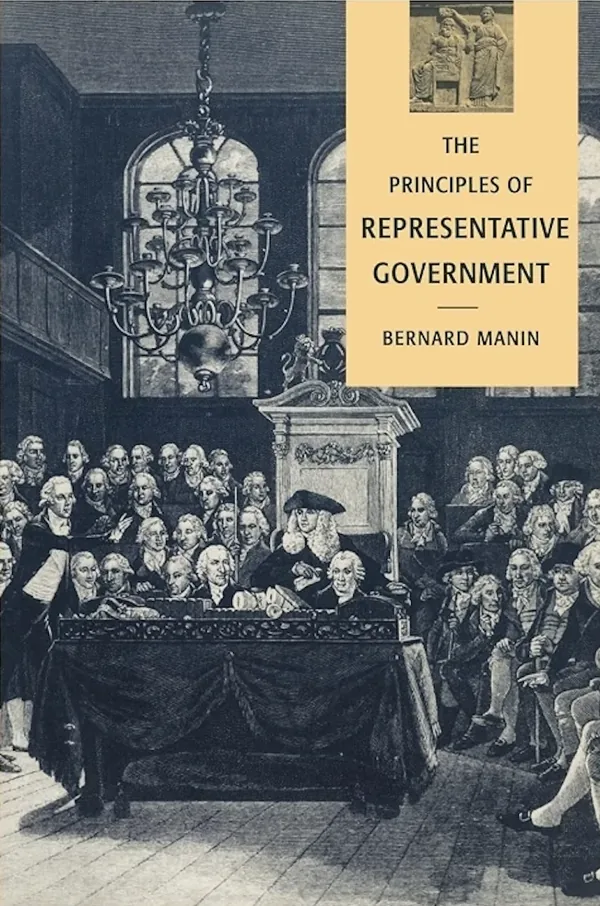
Part of Sciences Po’s democratic theory reading list, Bernard Manin’s landmark work examines the historical and institutional foundations of representative democracy. It challenges the idea that representative government is simply indirect or scaled-up direct democracy because large populations “cannot gather in one place to use lot system”.
Instead, Manin argues that representative government combines democratic and aristocratic (i.e., undemocratic) elements because, when these institutions emerged during the 18th-century revolutions in Europe and America, they were deliberately designed against “democracy proper,” including selection by lot.
The work confronts the notion that electoral representation is inherently democratic by highlighting that elections demonstrate an “aristocratic” character: while voters are choosing their rulers freely, the process itself favors superior and privileged candidates, and citizens are not equally able to become rulers.