Prominent Belgian political theorist Chantal Mouffe argues that political conflict is an enduring part of democratic life and suggests that replacing antagonism with rational consensus misunderstands the nature of politics. Her central proposal, agonistic pluralism, holds that democratic institutions should not abolish political divisions but transform destructive antagonism into legitimate contestation between adversaries.
A major target of Mouffe’s critique is the emphasis on rational consensus associated with John Rawls and Jürgen Habermas, as well as “Third Way” politics, which sought to move beyond traditional left/right divisions. Instead, she draws on thinkers such as Carl Schmitt, Ludwig Wittgenstein, and Jacques Derrida. She accepts Schmitt’s insistence on conflict but rejects his conclusion that liberalism and democracy are ultimately incompatible.
Arguing that expanding consensus does not necessarily strengthen the democratic system, Mouffe claims that when dominant political movements suppress less visible ideological alternatives, many conflicts remain unresolved. In such a scenario, she sees a healthier democratic response in contestation within established institutions that let opponents stay adversaries rather than become enemies.
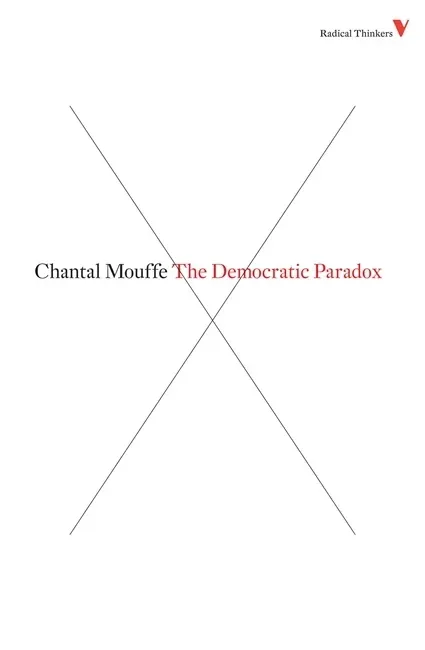
The Democratic Paradox offers an important exposition of Chantal Mouffe’s broader theory of radical and agonistic democracy: pluralism, as she understands it, entails recognizing that certain political disagreements have no—and will never have—a definitive, universally rational solution.